Tuesday, April 21, 2009

Peak Oil and Snouts in the Trough


Peak Oil is a highly contentious issue in the realm of conspiracy theories. Either the earth is running out of oil, or about to run out of oil and the oil companies are lying and saying there's plenty left, or there's plenty left and the oil companies are lying and saying oil is scarce. Taken at face value either is plausible given the motive of vast amounts of money. According to the Fortune 500 rankings for 2009, Exxon-Mobil are now not only the most profitable company in the world (as they have been for years), but also the company with the highest revenue in America, the world's largest economy. Prior recent rankings generally had them in second position for revenue behind retail conglomerate Wal-Mart but this year they've done them on both fronts. With revenues just shy of $443 billion and profits of $45 billion they are a latter day Standard Oil Company.

Recently published Forbes figures show not only that wanted Mexican drug barons can still be included in richlists as long as they are wealthy enough, but that big oil is still big. Last year's figures show 7 of the 10 most profitable firms are oil companies. Petronas of Malaysia made an appearance in 8th position as the most profitable company in Asia. This year, PetroChina had that honour. As the names imply, they are both oil interests.

In a year where banks and retailers suffered the top 6 most profitable companies were oil giants, with combined revenues into trillions of dollars and combined profits nearing $200 billion. The two most profitable companies in the US, the most profitable in China (and ultimately Asia), in Russia, the UK and Europe are big oil. So the motive to tell lies is there in abundance, and certainly someone's telling lies. The popular Chinese paper China Daily reported that not just one but three Chinese firms are in the shortlist of the most profitable in the world. Along with PetroChina, the Industrial and Commercial Bank of China (ICBC) and China Mobile were all reported to be in the top 10.

They aren't. They're all in the top ten for market value, but not profits. Likewise, China Daily cited ICBC as saying they are now the most profitable bank in the world. Again, this isn't true, according to the Forbes figures Banco Santander has that crown, though ICBC is the highest ranked bank for market value. You might think this was just down to confusion but there's a huge difference between market value and profit, and the English edition of People's Daily (another Chinese newspaper), got the story right. So China Daily, owned by the Communist Party of China just as People's Daily is, is lying about the status of its companies, presumably because market value isn't considered as important for propaganda purposes as profits. Doubleplus good.

Similarly, Peak Oil involves a misapprehension of the potential problem and a lot of deception, by pretty much all of the people involved. It was originally developed as a theory by M King Hubbert, who worked as a researcher for Royal Dutch Shell, a company with long standing ties to the French arm of the Rothschild family and the Bilderberg Group. Indeed, Nathan Mayer Victor Rothschild, the 3rd Baron Rothschild, was head of research for Royal Dutch Shell for several years in the 1960s despite his training being in biology, not hydrocarbon geology.

These days the theory is little advanced, and is propagated by the likes of Mike Ruppert, a 'former' CIA man who advances the theory that 9/11 was engineered or allowed to happen to enable the mobilisation of the US military to take control of the world's last remain oil and gas reserves in his book Crossing the Rubicon. The book is full of graphs that look just like the one presented by Hubbert in this short video:


Essentially, the theory is that global oil production will reach its peak approximately now, in the few years following the turn of the 21st century. The graph of production over time is a bell curve, with a rapid rise to the peak and a rapid fall away from it. There are numerous problems with this statistical manipulation.

Firstly, it assumes to know how much oil there is in the world, often referred to as Total Recoverable Reserves. This is a combination of Recoverable Reserves (oil in the ground that we already know about) and Yet To Find, an estimate of how much oil there's left out there that we don't know about. Once again we see the unknown unknowns of Team B's Communist threat and the more recent terrorist threat, and Iraq's WMD. We don't know how much oil is out there left to be found, so we'll assume there's an amount consistent with the prediction we want to make about when the peak in oil production will happen.

Secondly, it assumes that the extraction of oil is uniformly difficult, or easy. For example, if it's easy to get 90% of the world's oil but only particularly difficult to get the last 10%, then it's only as we approach having to extract that last 10% that we'll hit the problems identified by Ruppert et al. If, by contrast, only the first 10 or 15% of the oil is easy to extract, and there's another 85% of it buried deeper than present technology allows us to get, the problems come much more quickly. This itself is not only dependent on the physical amount and location of the oil, but also the technological development of equipment to locate and extract it, which is again something Hubbert could not know in the 1950s, and we cannot predict now. If we've reached the limit of such technology already then once again, the peak will happen earlier. If we've some way to go on the development then the peak will come later.

Thirdly, and perhaps most importantly, is the misuse of language by the thousands of people claiming to be experts. 'Peak Oil' refers, in the language of almost everyone who talks about it, to a peak in oil production. However, we don't produce oil. We extract it, ship it around the world, split it up, refine it, and convert it into useful things like petrol and plastic. Nowhere have we actually produced anything that wasn't there before in a modified form. The actual production of oil is something of a contentious issue. While there's a consensus that it is a fossil fuel produced biogenically, i.e. from organic matter, the abiogenic theory has yet to be comprehensively refuted.

Regardless of what actually makes oil, it must come from somewhere, be produced by some process. The figure never referred to in any calculation of peak oil that I've seen is the amount of oil being produced by the earth over any given period. When you have a system whereby oil is being produced, somehow, and then extracted by us at a certain rate then the point at which we run out, or even begin to run out, is affected by the rate of production as well as the rate of extraction. However, by calling extraction production and ignoring real production altogether, a fixed point in time can be defined in what's actually a dynamic process. This is then endorsed by thousands of scientists who are either so stupid as to not realise what they've missed or are actively participating in a deceit.

Sadly, the same is true of so many critics, commentators and alternative theorists/conspiracy theorists. In taking peak oil for granted, they use it as an assumption to inform on other topics. Peak Oil was the motive for 9/11, according to Ruppert. Indeed, many in the 9/11 movement buy into this notion without critically examining in the same way they examine the terrorist attacks and the possible culprits. Likewise, many in the environmental movement talk about Peak Oil alongside Climate Change, blaming the world's woes on big oil companies in a vaguely anticapitalist gesture.

Consider that the Shell CEO Jeroen Van Der Veer (Bilderberg) is now officially endorsing Peak Oil theory as a reality. Consider that Exxon Mobil in June 2007 issued an official statement saying it had never doubted the threat from Climate Change. Then, in May 2008 a 'revolt' led by the Rockefeller family (major shareholders) led to them ceasing to fund 'climate change denial', i.e. research countering the finding of the IPCC. In January 2009 the world's largest oil company then joined the ranks of those calling for a worldwide carbon tax. Consider that JP Morgan Chase, the world's largest private derivatives player, have bought a carbon credits firm. Along similar lines they are even subsidising the production of low-energy stoves to be distributed in Africa, on the face of it a noble and benevolent scheme. However, because the stoves use less energy (and thus produce less carbon dioxide), they generate carbon credits. NM Rothschild's Australian branch is also looking to lead the way in the new economy with their Carbon Ring Consortium. Similarly, Barclays launched the first index for the developing carbon trading market in December 2007, following JPMorgan Chase's creation in February 2007 of the world's first bond index designed to address the risks of climate change. Unsurprisingly, at the heart of Barclays, Exxon Mobil, Royal Dutch Shell, and JP Morgan Chase are the Rothschilds and Rockefellers. To say that the world's leaders are denying the reality of peak oil and/or climate change so they can keep making money is simple ignorance.

Beyond that, there is the possibility of Peak Oil being an outright lie. Lindsay Williams and others have spoken of vast reserves in Northern Alaska around Prudhoe Bay and Gull Island. The largest untapped field in the world, and fifth largest ever discovered is Kashagan in Kazakhstan, only discovered in 2000. Carioca, an offshore field near Brazil, has recently been estimated to be the third largest ever discovered. In February 2009 Permex, the Mexican oil company, announced that the world's biggest oil field had been found but that due to technological constraints it couldn't expect to access most of it until 2040. Obviously these estimates will have to be proven and the extraction of that oil is subject to geological, technological, economic and political constraints but that's exactly the issue at stake, that the amount of oil available to us at what point in time and at what price is dependent on a great many factors outside the statistical estimates of peak oil experts.

At the Veterans for Peace convention in 2006, when asked whether Peak Oil was an 'oil company conspiracy', author and former economic hit man John Perkins replied:

"Peak Oil is not only an oil company conspiracy, it's a misconception in economics. Peak Oil, any kind of a calculation like that, is based on assumptions. The old Peak Oil assumption was on the basis of I think 30 or 40 dollars a barrel, and under that assumption the analysis was pretty accurate. But today oil is priced at over 70 dollars a barrel so the old Peak Oil conclusions are totally off the wall...

...So, Peak Oil, our measurements of that whole theory of Peak Oil and when it comes to an end, is dependent on what price of oil you put. As you increase the price of oil, you increase the places you can get it from." - John Perkins, VFP Convention
The speech and Q and A session is in three parts, here, here and here. Pointing out the profits made by Exxon Mobil, Perkins went on to say how the fact that supply is restricted because of the wars in the Middle East is actually to the oil companies' advantage. Canada's reserves are said to be second only to Saudi Arabia's, and in the midst of the global recession Shell and Exxon are looking to buy up Canadian firms and therefore a stake in those fields, and again they're not letting a good crisis go to waste.

This hints at one distinct possibility, which implies Obama's talk about ending America's dependence on foreign oil is actually a real policy, not just election talk. Only this week there has been discussion in the news of the Roan Plateau in Colorado, previously considered a reserve in case of extra demands in wartime. When America put its currency on the Saudi Oil standard in the 1970s, it essentially pinned the value of its currency on continuing supplies of oil from Saudi Arabia, and them denominating their oil trades in dollars. The price of a barrel of oil is almost always quoted in dollars as a result of this deal. However, much as there's reason for scepticism about global Peak Oil, there's a real possibility that the Saudis are running out.

At Ghawar, the world's largest oil field until recent developments suggested otherwise, they are injecting millions of barrels a day of sea water into the wells to sustain oil pressure. This is nothing new, injections of water are quite common. But the proportion of water coming back out in the oil is up to 30%, which means they're pumping millions of barrels of oil out of the ground that's 30% sea water because they've had to pump in so much water to keep the oil flowing. This is where the North American Union comes in. Canada and Mexico have vast oil reserves, Canada also has a lot of wood and water, and Mexico has a massive labour force.

If the US stops importing oil from the Saudis then the Saudis no longer have vast revenues with which they can buy the US debt. Without the ability to borrow money, the very real bankruptcy of the US government would become obvious. By combining the US, Canada and Mexico economically, they not only have a much larger tax base to service the debt, making it more appealing to China and India and Japan, but also control of significant oil reserves to replace the Saudi imports. However, this would probably lead to the collapse of the Saudi royal family and regional civil war, so they need an excuse to cover the area in military bases so that they can maintain a certain grip on the region.

Also this week, Hillary Clinton (Bilderberg) declared that Pakistan poses a 'global threat' because they're letting the Taleban control parts of the country. In the fallout from the release without charge of every person involved in what the authorities told us was a 'very big plot', Pakistani officials have expressed their anger at constantly being associated with terrorism and blamed for it. They have a point, in that since the attack on Iran was shelved, Pakistan has taken their place as the country most often associated with the threat from terrorism. On the other hand, the Pakistanis have a long history of collaborating with paramilitary groups that are in effect indistinguishable from terrorists in the rather broad sense that we tend to use the word. The Pakistani ISI was critically involved in Operation Cyclone, the decade-long funding, arming and training of Arabs to fight against the Soviets in Afghanistan. I doubt the Americans will launch a military invasion of Pakistan, though it is possible, but given the influence of Kissinger and Brzezinski I think a less direct approach is planned.

Of course, all this constitutes a conspiracy theory, but one in keeping with the sorts of plans executed by a globalist superclass over the last decades and centuries. Nonetheless, the future is never set in stone and the potential for change is always here. Peak Oil may prove to be the reason, or the excuse, for mass depopulation. In an e-mail discussing the debate on the possible abiotic origin of oil, Michael Ruppert admitted:
"I advocate an immediate convening of political, economic, spiritual and scientific leaders from all nations to address the issue of Peak Oil (and Gas) and its immediate implications for economic collapse, massive famine and climate destruction (partially as a result of reversion to coal plants which accelerate global warming).

This would, scientifically speaking, include immediate steps to arrive at a crash program - agreed to by all nations and in accordance with the highest spiritual and ethical principles - to stop global population growth and to arrive at the best possible and most ethical program of population reduction as a painful choice made by all of humanity." - Ruppert
Ruppert advocates the convening of leaders to develop a program of population reduction but somehow has the gall to call this a 'painful choice made by all of humanity'. No genocidal plan developed by groups of world leaders is even approximate to a choice made by all. It is ludicrous that Ruppert, a man who prides himself on blowing the whistle and critically dissecting propaganda would subscribe to such a horrific view of the world and advance it in such deceptive terms.

Once again we see people abusing their positions of authority, sometimes due to professional or social context and sometimes due to loyalty to a private network. By advancing such a view, Ruppert is allying himself more with the likes of the Bilderberg Group and the Club of Rome than he is with similar critics and theorists. As noted by Dave McGowan (to whom Ruppert's above e-mail was sent), Fletcher Prouty, a former Air Force Colonel and longtime whistleblower and Kennedy assassination theorist, advances not only that Peak Oil is a myth but that oil is abiotic in origin. Though Ruppert's From the Wilderness site is part of the independent media that discusses such theories, it consistently ignores such articles from similarly independent websites which contradict the desired view. As Chris Bennett describes on the excellent WorldNetDaily, there is an inorganic theory of oil production worthy of consideration:

The theory is simple: Crude oil forms as a natural inorganic process which occurs between the mantle and the crust, somewhere between 5 and 20 miles deep. The proposed mechanism is as follows:

  • Methane (CH4) is a common molecule found in quantity throughout our solar system – huge concentrations exist at great depth in the Earth.
  • At the mantle-crust interface, roughly 20,000 feet beneath the surface, rapidly rising streams of compressed methane-based gasses hit pockets of high temperature causing the condensation of heavier hydrocarbons. The product of this condensation is commonly known as crude oil.
  • Some compressed methane-based gasses migrate into pockets and reservoirs we extract as "natural gas."
  • In the geologically "cooler," more tectonically stable regions around the globe, the crude oil pools into reservoirs.
  • In the "hotter," more volcanic and tectonically active areas, the oil and natural gas continue to condense and eventually to oxidize, producing carbon dioxide and steam, which exits from active volcanoes.
  • Periodically, depending on variations of geology and Earth movement, oil seeps to the surface in quantity, creating the vast oil-sand deposits of Canada and Venezuela, or the continual seeps found beneath the Gulf of Mexico and Uzbekistan.
  • Periodically, depending on variations of geology, the vast, deep pools of oil break free and replenish existing known reserves of oil...

...Could this be true?

In August 2002, in the "Proceedings of the National Academy of Sciences (US)," Dr. Kenney published a paper, which had a partial title of "The genesis of hydrocarbons and the origin of petroleum." Dr. Kenney and three Russian coauthors conclude:

The Hydrogen-Carbon system does not spontaneously evolve hydrocarbons at pressures less than 30 Kbar, even in the most favorable environment. The H-C system evolves hydrocarbons under pressures found in the mantle of the Earth and at temperatures consistent with that environment.

He was quoted as stating that "competent physicists, chemists, chemical engineers and men knowledgeable of thermodynamics have known that natural petroleum does not evolve from biological materials since the last quarter of the 19th century." - Chris Bennett, WorldNetDaily

Perhaps it is a lack of willingness to discuss this possibility that leads Peak Oil commentators to so nakedly ignore the question of how much oil is produced, by whatever process, over the timescales discussed for various Peak Oil scenarios. In the absence of certainty over where oil actually comes from all we're left with is speculation and conspiracy theories about what knowledge is reliable bearing in mind the vested interests of the authorities involved. Curiously, a point similar to this is made in a Channel 4 documentary on conspiracy theories by Nafeez Ahmed, himself a Peak Oil theorist who has suggested a cover-up on the part of the oil industry. Ahmed, who is an excellent writer and researcher in many respects, has said he believes we have already passed the peak of oil production, and mostly advances the theory that the US military and/or government were complicit in 9/11.

Ahmed's comment in the show, titled Who Really Runs the World? and narrated by an extra from a cockney gangster movie, is probably ripped out of context because it is presented as a criticism of conspiracy theories in general, and having studied his work for some time I don't believe Ahmed is capable of such immense hypocrisy.


The show itself is marginal improvement on the BBC's
Conspiracy Files, though not as good as Jon Ronson's series for Channel 4 some years ago, The Secret Rulers of the World. Indeed, only Ronson's tries to break away from the established mainstream media line, that all conspiracy theories are wrong and that all conspiracy theorists are fantasists, loners, idiots and so on. Having interviewed a total of three conspiracy theorists (including crackpot doyen David Icke), they dedicate most of the second half of the show to one of the most laughable, unscientific experiments I've ever seen on a television programme.

A professor and a doctor, portrayed as experts on 'conspiracy thinking', are shown conducting a psychological exercise which, while superficially confirming their conclusions actually proves them to be false at closer examination. As they are introduced, they admit that they aren't interested in whether a particular conspiracy theory is true, but from a 'psychological perspective' why some people believe in them and some don't. The suggestion that people might actually believe in conspiracy theories on the basis of evidence is evidently not part of the discussion.

30 students were given a rudimentary psychological evaluation, a paper questionnaire, aimed to assess three 'factors' - low levels of trust, feelings of alienation from society, and propensity to make assumptions. The experts predict those who score highly for these factors will be more prone to believing in conspiracy theories. From the results of these tests, two groups of six, the highest scoring and lowest scoring, are drawn. They are then sat down as groups as asked what they think of a 'brand new' conspiracy theory created by the two doctors. The theory? That the government is using mobile phones to track everyone all the time.

Herein lies one problem, these two men claim to be experts in conspiracy thinking, and so you'd think they'd have some familiarity with conspiracy theories, if just to get a sense of the range of opinions and views, in which case they'd realise this theory is far from new. Indeed, similar techniques have been depicted in popular spy shows like Spooks for years before the making of this documentary. Furthermore, as psychologists they must have realised that by putting this theory to them as groups instead of individually that their responses would be more likely to develop via what is called 'groupthink', essentially where opinions are voiced more due to them being obviously acceptable in the specific social context rather than on the basis of a rational or impassioned process.

So they discuss the theory for a bit, kick some ideas around about it's possible limits, and are then asked to vote in the hands up in a crowd way that they used to hold general elections until people pointed out it made it difficult for anyone to dissent. That's why we have secret ballots today, and in some countries have for the better part of two centuries. It's hardly a radical standard to expect of people aspiring to get to people's real opinions. Throughout the discussion and voting in the show, people in the groups are shown looking to others for validation and confirmation of their opinions. When the group predicted to be conspiracy theorists are asked to vote on if they think it is 'very likely or quite likely' to be true, all six voted yes, it was quite likely. When the other group were asked to vote on if they thought it was 'certainly not' true, five of the six voted yes.

However, given that the original test was meant to assess how prone the students were to making assumptions and leaping to conclusions and that the group who were meant to be sceptical were more certain in their beliefs, that the theory definitely wasn't true, it renders the whole experiment meaningless. Likewise, the group predicted to be more likely to believe in conspiracy theories were discussing the theory not literally in the sense of tracking everyone all the time, but the possibility of tracking people in that way, they weren't really voting on the original statement. Similarly, a dozen middle class students being asked about one poorly articulated conspiracy theory doesn't test anything on a wider scale. Despite this setbacks, or possibly in total ignorance of them, the show declares the experiment's results 'conclusive'.

Taking the results off to meet David Icke, one of the experts asks for his opinion on a 'large scale survey' they carried out. Responding to the allegation that people believe in conspiracies because it serves a psychological purpose, Icke responds by saying that people have looked at the evidence and realised they're being lied to. The expert responds by saying that for some of Icke's claims there is next to no evidence, but when prompted admits he hasn't actually read Icke's work, only read about it. This invalidates the entire process and the claim to expertise, because one cannot expect to be able to reasonably comment on work which one hasn't actually seen or read, and to seek to assess such beliefs solely through the framework of psychology is a waste of time.

No doubt, some people's experience and predilections will inform what they believe, perhaps everyone. But belief in conspiracy is as common as eating bread. Banks conspire to award huge bonuses to irresponsible directors, people conspire to murder out of jealousy or revenge, families conspire to keep secrets in the closet - the mainstream press is full of such stories, particularly 'real life story' magazines. However, by defining certain conspiracy theories as such and referring to other conspiracy theories via a different name, one can maintain a false distinction and design fraudulent, circular experiments to try to justify a means of classifying not only beliefs but also the people who believe in them.

Like the Peak Oil calculations, the aim is not a rigorous and careful investigation of the facts and the use of that information to develop sound policies, but to classify beliefs in ways conducive to political purposes. By tagging anyone who suspects the governmental and corporate elite as a conspiracy theorist they can discourage dissent and suspicion, as well as manipulate discussion of issues so that science and logic are made subservient to political demands. Just about any belief on the subject of Peak Oil, short of flat out denial of it being worthy of discussion, involves a conspiracy theory, in part because of what Nafeez Ahmed identifies, the lack of certainty requires some speculation in order to have a specific view of the world. Anyone who wants to be seen by the mainstream as an expert, or even just an authority, cannot explicitly endorse a conspiratorial worldview, at least not without calling it something else.



Monday, March 23, 2009

Dirty Wars


This week the UK government launched its new counterterrorism strategy, called Contest Two, though it was leaked weeks ago to the BBC who covered the story in their programme 'Muslim First, British Second'. The central policy is to target those Muslims, called 'conservatives', who speak out against democracy or homosexuality, or in favour of misogyny and so on. A central aspect to this strategy is the question of how the four homegrown suicide bombers of 7/7 were motivated to commit acts of mass murder, as noted in the opening paragraph of the BBC article above. The fact that the government's narrative cannot even plausibly explain how the four alleged suicide bombers got to London is totally ignored. Perhaps the press were intimidated by the policy of targeting anyone who disagrees with what the government define as 'British values'. After all, one of the targeted groups are those who fail to speak out against the killing of coalition soldiers in Iraq and Afghanistan, the implication being one not only has to accept democracy, capitalism, a specific sexual spectrum and an extremely limited notion of gender equality, but also the paradigm that is the 'war on terror'.

The BBC Panorama show is a textbook example of how disinformation is used to justify a government agenda, as well as why the policies employed by the government fail to confront the very real associations between our defence institutions and militant Islamic fundamentalists, and hence fail to confront what actually poses a risk to national security. The show's presenter, Richard Watson, essentially tells the same story in this BBC article.

First up 'we haven't had a major terrorist attack since July 7th 2005'. How easy it is to ignore the fact that accounts of what happened vary tremendously and not even dedicated researchers have come up with a comprehensive version, let alone the police or the Home Office. The show goes on to cite the case of Nicky Reilly, who was sentenced to life imprisonment in January 2009. While the show notes that Reilly had a low IQ, and Aspergers Syndrome, and that his apparent terrorist attack was a total failure, injuring him as he prepared a bomb in a restaurant toilet in Exeter, it fails to discuss the nature of the bomb. Kerosene, caustic soda and nails is not a particular potent combination in bomb-making terms, as it contains no explosive material. Such a combination could theoretically be fatal, but given one-third of the bomb only caused relatively minor injuries to Reilly himself this indicates this wasn't designed or built by a 'professional' terrorist. Nonetheless, the BBC show and much of the press coverage say that Reilly must have been influenced and radicalised by some local Al Qaeda member. However, no one seems to have a clue who this person might be, so whether they were indeed a militant fundamentalist or something else, a provocateur for example, is anyone's guess.

The show then goes on to spend a few minutes with Watson pouring congratulation on himself and trying to build up his credentials with images of him at meetings of Muslim 'extremists' and 'conservatives'. Eventually, he is confronted by a man who'd evidently seen some of Watson's prior shows on the same subject who denounces the BBC man as an 'enemy of Islam', a 'liar and a fabricator'. Watson responds saying this is 'total paranoia' and that 'we report the facts'. As we've already seen, the case of Nicky Reilly is treated by Watson (and many others) in a partial manner that without evidence attributes responsibility to Islam and Muslims.

Watson shows similar partiality and bias in his depiction of Omar Bakri. Entirely focussing on Bakri's role as a fundamentalist preacher the show ignores that Al-Muhajiroun, the organisation Bakri was deeply involved with, was itself a tool of recruitment by western intelligence services for mujahideen to fight in the dirty wars in the Balkans. Similarly, no mention is made of Bakri's longstanding association with MI5. Lies of omission, perhaps, but lies nonetheless and therefore far from credible journalism. Likewise, when discussing the lack of trust Muslims have for British institutions the show includes an interview with a man who doesn't believe that Khan, Tanweer, Lindsey and Hussain were responsible for 7/7, to which Watson incredulously responds 'come on'. If the Panorama man was willing to do even the slightest earnest research he'd discover that the case against Khan et al. is extremely slim and circumstantial. This is the entire BBC show, which continues in this misleading vein to its conclusion.


The policy itself is a nonsense. One aspect of it was discussed in a BBC article titled 'Thousands getting terror training'. The title is ironic as it cleverly implies that thousands of terrorists are getting trained when in fact it refers to 60,000 UK workers who have or will receive training which, in the BBC's words, will make them '
able to deal with an incident'. Presumably the remaining 60 million or so citizens of the UK will just have to make do without. As noted by shadow Home Secretary Chris Grayling, the training is a voluntary 3-hour seminar, which is less than half the length of a cycling proficiency course. Though it's probably fair to point out that you're more likely to die on the roads than you are in a terrorist attack, so maybe this is an indication that the government finally realises the disproportionate attention paid to the threat of terrorist attack.

Maybe not, since the newly updated and enhanced Contest Two strategy was announced with a declaration that, as ever, we're facing an increasing risk of terrorist attack. The International Herald Tribune, CNN, Al Jazeera and others ran stories headlining the growing risk. In particular the press discussed the threat of a dirty bomb, something that has lapsed in coverage in the last couple of years in favour of ludicrous plots about making liquid chemical explosives in airliner toilets. As covered in The Power of Nightmares, the threat from a radiological dirty bomb is minimal.


The reformed dirty bomb threat shows at least some awareness of this, in that they're now talking about a chemical or biological attack. The Contest Two strategy says:

"Changing technology and the theft and smuggling of chemical, biological, radiological and nuclear and explosive (CBRNE) materials make this aspiration more realistic than it may have been in the recent past." - Skynews
When asked about whether this sort of attack was now more likely, Home Secretary Jacqui Smith offered a perplexing response.
"There is the potential, given the international situation, what we believe to be the aspirations of some international terrorists, that it could be." - Jacqui Smith, Skynews
There is the potential that it could be? Not just the ambiguous 'it could be', but even more speculative, 'there is the potential... that it could be'. Top marks to Jacqui Smith for the most meaningless opinion on the terrorist threat that I've read in months. It's almost insulting to (sic) hardoworking advertisers to call this a PR campaign but needless to say it's no coincidence that the same day the govt. rolls out a 'new' anti-terrorism strategy that the news is full of stories about the threat of a dirty bomb. However, Jacqui did stop to praise the work done in the war so far, saying 200 people had been 'brought to justice' for 'terrorism related offences.' As previously discussed on this blog, those 200 people were far from hardened terrorists committed to devilish conspiracies, but largely consist of dreamers, incompetents and the outright innocent. Still, it helps make it look like there's a need for what they want to do. In a truly bizarre footnote to this PR, Richard Watson's article on his own Panorama programme would claim:
Judging by the number of terrorist plots under investigation by MI5 - more than 200 - there is no shortage of young Muslims who are learning to view Britain with hatred. - BBC
There's no way in hell the government is monitoring 200 terrorist plots, even its own figures (apparently unaffected by imprisoning terrorists or by the rising threat) consistently repeat the numbers of 2000 people, 200 networks and 30 plots. That Watson is either too stupid or ignorant to be able to distinguish between a network and a plot, or is knowingly confusing the two, should disqualify him from being paid for his opinion on such issues. Alas, the BBC is likewise either so incompetently run that people like Watson continue to peddle their crap or is actively involved in precisely these sorts of deceptions that make people like Watson useful.

The flagship aspect of this policy is that the enemy in this war is redefined not only as terrorists and those who speak or write in favour of violence but those who don't believe in particular versions of sexual and gender equality, or don't recognise the authority of the police and state. I invite you to recall George HW Bush's words at the Jerusalem Conference of '79:
"Lest we blunt our own devotion to individual freedom, we must not close our eyes to the existence of terror in any form anywhere in the world, for such tolerance makes us vulnerable to the cancer of international terrorism by weakening our confidence and our resolve...

...Above all, as free men, we must assiduously cultivate the habit of fierce and merciless resentment towards all those who disrupt public tranquility; this habit will make us safe and keep us free." - Bush, International Terrorism
'Terror in any form' now includes not believing in the right of homosexuals to live, love and marry according to their desires, according to the Home Office. However, consider that California, with its long-established gay communities and generally progressive politics only allowed gay marriage without a court order in 2005, and that the vote was 21-15, hardly a glowing endorsement of the policy. Indeed, since 1996 the Defence of Marriage Act has been in force in the USA, which prevents federal treatment of same-sex marriages as valid. The conclusion implied by all this is that the enemy now includes the federal govt. of the USA.

Also implied by this policy is that targets will also include essentially anarchist groups like the Socialist Party of Great Britain, who oppose the state, including the police and armed forces and therefore the rule of law in its most naked form, at least so long as it continues to 'serve the monopoly of the capitalist class'. Likewise, those demanding culpability for any of the 30+ cases of British police officers fatally shooting people in the last couple of decades, who have so far seen not a single prosecution, could be seen as refusing to respect the rule of law. There is the odd exception, as recently shown in the remarkable case of the Cardiff Three when 13 police officers were charged with perverting the course of justice. However, trying to hold the police to account remains very difficult, and this sort of government strategy will only make it more so.

There has also been considerable criticism from those most likely to be targeted, ordinary Muslims. The Muslim Council of Britain and the Islamic Human Rights Commission have both warned that it will be counterproductive to the stated aim of producing community cohesion.
MCB expressed serious alarm that the government may be in “danger of adopting misguided notions of extremism as dictated by xenophobic commentators who profit from creating a hostile atmosphere from which bigots of all shades can draw.”

“A definition of ‘extremism’ that would classify the overwhelming majority of loyal and law abiding British citizens as extremists would be of no value in our common fight against terrorism,” the umbrella organisation warned after over 200 prominent Muslim civic and religious leaders held a meeting in Birmingham last Saturday...

...Contest-2 cannot be viewed in isolation but is just the latest chapter in a trend of creating, promoting and funding Muslim institutions which will promote the government’s version of acceptable Islam, under the guise of community cohesion, said IHRC chair Massoud Shadjareh. - Globalsecurity.org
It seems that for all the freedom, multiculturalism and diversity we're fighting to protect, it's only the freedom and diversity defined by the state that will be supported, everything else will be opposed. You don't have to actually do anything to manifest your views, just holding the opinion that, for example, homosexuality is immoral is enough to get you targeted by 'community led intelligence efforts'. If someone tries to petrol bomb a gay bar or throw paint at lesbians then it is entirely consistent with laws common to most countries that they be treated as criminals and punished proportionally. But if they merely hold derogatory opinions about people, maybe wave the odd placard or publish the odd article then they're actually just claiming a right that is meant to be one of the foundations of this country - the right to hold opinions and express them, regardless of if they are informed, valid, or true.

The critical thing missing from this new counter-terrorist strategy, not that I for one moment thought it would actually be included, is the confrontation of the ongoing policy of making use of Islamic militants to further the imperial aims of the Anglo-American axis of evil. One of the more recent examples is that the group whose training camps were allegedly visited by members of the liquid bomb plot conspiracy, Jundullah, has been a US proxy in the Middle East, running raids across the border in Iran since 2005. This sponsorship of such militant groups in the Middle East extends to hundreds of millions of dollars. Following a bombing in Iran in February 2007, several members of Jundullah were arrested.
IRNA quoted an unnamed "responsible official" late Friday as saying that one of those arrested on charges of involvement in Wednesday's bombing, identified as Nasrollah Shanbe Zehi, has confessed that the attacks were part of alleged U.S. plans to provoke ethnic and religious violence in Iran. - CBS
While this policy continues any efforts to discourage radicalisation through community cohesion, or to train everyday shopkeepers in what to do if they hear a bomb go off is, frankly, pissing in the wind. Naturally, government policy isn't actually aimed at putting an end to terrorism because it's such a useful brand, as well as such a useful instrument to destabilise target countries. Plus it's big money, one figure widely quoted in the announcement of the new policy/increasing threat from dirty bombs is that by 2011 the government will be spending £3.5 billion a year on counterterrorism. To help put that in perspective, the total revenue of the English football Premiership this season is estimated by Deloitte Consulting to be in excess of $3.6 billion, which makes fighting terror bigger business than getting your salary from Roman Abramovich's overdraft.


(Government propaganda follows)


Saturday, February 21, 2009

The conference part three: Ends and Means


A further speaker at the Jerusalem Conference on International Terrorism (JCIT) was Paul Johnson, a British historian, author of some 40+ books and a former adviser to Margaret Thatcher. George Bush II awarded him the Presidential Medal of Freedom. He has written for The Spectator and was also editor of the New Statesman. One of his sons founded Standpoint, a conservative political magazine, another is a multi-millionaire greyhound track merchant and chairman of British Channel 4 since January 2004. Paul Johnson, a conservative Catholic, spoke of 'seven deadly sins of terrorism', and it is possibly the most lengthy and complex commentary of any speech at the conference.

Initially, Johnson sought to adopt the clean binary moral oppositions of other speakers.

"The truth is, international terrorism is not part of a generalised problem. It is a specific and identifiable problem on its on; and because it can be isolated from the context which breeds it, it is a remediable problem. That is the first thing we must get clear." - Johnson, International Terrorism
It is a contradiction in terms to think any such problem can be isolated from the context which breeds it, as long as that context continues to exist. One could, theoretically, kill all the terrorists alive today. But that won't stop people becoming terrorists in the future. In fact, it could make it more likely. Implicitly, Johnson is here employing the same philosophy as Pipes, Bush and the rest, of terrorism being an other, opposed to the civilisation of the west. He went on to claim:
"It is almost impossible to exaggerate the threat which terrorism holds for our civilisation. It is a threat which is in many respects more seriously than the risk of nuclear war, or the population explosion, or global pollution, or the exhaustion of the earth's resources." - Johnson, International Terrorism
Shortly before leaving office, Bush II warned the incoming Obama that terrorism was the greatest threat to the US, a view endorsed by the US Dept. of Defense, the CIA and Interpol. Similarly, the last head of MI5 and the current one have given speeches and press conferences on the terrorist threat. Similar sentiments have been expressed regarding Germany, France and Russia. This is once again a kind of doublethink, that it is simultaneously impossible to overestimate the threat from terrorism, yet it is possible to distinctly isolate that threat from the context giving rise to it. It is a unknown known, if you like, something that is affirmed as being known at the same time as an affirmation which makes knowing it impossible. Frankly, it's horseshit.

The deeply religious and moralistic Johnson would go on to paint a near-apocalyptic vision of that threat, seeking once again to institute a binary opposition, between terrorism and civilisation. After discussing comments by 18th century writer Edward Gibbon, he said:
"Now, nearly 200 years later, we cannot be so sure. The principles of objective science and human reason, the notion of the rule of law, the paramountcy of politics over force, are everywhere under growing and purposeful challenge, and the forces of savagery and violence which constitute this challenge are becoming steadily bolder, more numerous and above all, better armed." - Johnson, International Terrorism
Also in 1979, the French philosopher Jean-Francois Lyotard published his seminal essay The Postmodern Condition, which describes a similar challenge to the Enlightenment notion of civilisation to which Johnson refers. In particular Lyotard identifies two meta-narratives, or grand narratives - orientating ideologies that seek to explain history and justify the existence of institutions. The two in particular that concern him are the narratives of emancipation and speculation, which refer to the great Liberal and Marxist political traditions of using the state to improve the lives of the people, and the great logical and scientific traditions which use the discovery of knowledge to progress human society. Both narratives had suffered a tremendous beating by the reality of 20th century politics and history. The narrative of emancipation might tell a great story of liberating Europe from the threat of Nazism, but for all the millions killed and billions indebted what emerged was the Cold War, which would claim millions and billions more. Likewise, the narrative of speculation might tell of tremendous progress in medical technology but we've witnessed the increasing analysis and control of human behaviour and the domination of technology by the few for power and profit.

It is out of this failure of political and scientific ideologies of the Enlightenment that the institutions of power have seized on this Machiavellian philosophy of manipulating a threat to justify power.
"Without a doubt, princes become great when they overcome difficulties and obstacles that are imposed on them; and therefore Fortune, especially when she wishes to increase the reputation of a new prince, who has a greater need to acquire prestige than a hereditary prince does, creates enemies for him and has them take action against him so that he will have the chance to overcome them and to climb higher up the ladder his enemies have brought him. Therefore many judge that a wise prince must, whenever he has the occasion, foster with cunning some hostility so that in stamping it out his greatness will increase as a result." - Machiavelli
While the challenge to conventional power posed in the mid-late 20th century encompassed ideological, institutional and militaristic actions of varying kinds, Johnson sought only to focus on that which inspires the strongest emotions, the 'cleanest' moral response, i.e. violence, specifically terrorism. If they can make the public sufficiently outraged at the violence (real or perceived) of the other then it continues to justify our own violence. Curiously, it's the same strategy they accuse terrorists of using, which further undoes this apparently binary opposition between us and them.

So, to the seven deadly sins. Sin one:
"Terrorism is the exaltation of violence over other forms of public activity." - Johnson, International Terrorism
Proceeding to blame philosophers from Lenin to Nietzsche, by way of Hitler, Johnson concluded:
"The first deadly sin of terrorism is the moral justification of murder not merely as a means to an end, but for its own sake." - Johnson, International Terrorism
Having spent the previous several minutes talking about various philosophers who spoke of violence as a means to an end, he performs a u-turn of Blairite proportions and tries to talk of violence for its own sake, violence as an end in itself. But how can violence ever be an end in itself? Even sadists are seeking to satisfy some sort of craving or desire, and violence is only ever a means to that end.

We find this same idea of violence as an end in itself, or violence for its own sake, in the work of openly Zionist professor Louis Rene Beres. Beres is on the board of directors for the Freeman Center for Strategic Studies, who seek to 'aid Israel in her quest to survive in a hostile world' and chairs Project Daniel, a near identical thinktank. He specifically identifies the Palestinian terrorists as adopting this philosophy.
"Rejecting more instrumental views of force, Hamas, PLO and all other movement organizations have now come to regard terrorist violence as an end in itself." - Beres, Arutz Sheva
However, the PLO was founded on the basis explained in the Palestinian National Covenant.
"The Palestine Liberation Organization, which represents the forces of the Palestinian revolution, is responsible for the movement of the Palestinain Arab peole in its struggle to restore its homeland, liberate it, return to it and exercise the right of self-determination in it. This responsibilty extends to all military, political and finanacial matters, and all else that the Palestinian issue requires in the Arab and international spheres." - Article 26
Clearly Beres believes this has changed, yet since 1994 the PLO have had a Negotiation Affairs Department working to develop and implement the 1993 Interim Agreement. Despite this, Beres alleges that there is no cycle of violence in the Middle East, talking only of the violence 'for its own sake' of the Palestinians, and 'carefully limited Israeli retaliations'. Essentially repeating Johnson's claim of a threat to civilisation he wrote:
"For many of Israel's enemies[...] violence against Jews is deliciously naked, tantalizing only for the sheer pain its can bring to unbelievers. The aggressivity of this violence is disinterested in strategic gains or losses. It is politically unmotivated. It wills only its own will. It is pure irrationality." - Beres, Israel Insider
This categorical idea, that terrorists believe in violence for the sake of violence, is crucial to dehumanising them, making them seem like sociopathic automatons driven solely by the desire to hurt and kill. Out of the academic and into the popular realm, it also appears in MSN's Encarta Encyclopedia entry on terrorism.

Johnson's second deadly sin is one of the most perfect examples of doublethink I've yet encountered. Expanding on the baffling notion of motiveless violence he said:
"The second is the deliberate suppression of the moral instincts in man." - Johnson, International Terrorism
Without this, he goes on, it would not be possible for terrorists to indiscriminately slaughter people. Once again this is an extremely limited, self-serving understanding by an absolutist and a moraliser. For one thing, it's probable that the opposite is true - that without a system of moral distinctions, however invalid and psychotic, such violence wouldn't be possible. One of the reasons the US equipped, trained and funded the mujahideen in Afghanistan with such success is that a religious man who believes in the afterlife will happily fight to the death against the invader, in this case the Soviets. In particular we can see this in Brzezinski's visit to Pakistan where he told the fighters 'your cause is right, and God is on your side'.


Also, as Kubrick brilliantly portrayed in the boot camp section of Full Metal Jacket, all military and paramilitary organisations, not just terrorist groups, try to suppress the instincts of their recruits that aren't useful for warfare.


Beyond that, one only has to look at the letter from Osama Bin Laden, presumably the amoral terrorist in chief in Johnson's view of the world, to the American people to see that he in fact shares some of the concerns of Catholics, among others:
"The second thing we call you to, is to stop your oppression, lies, immorality and debauchery that has spread among you.

(a) We call you to be a people of manners, principles, honour, and purity; to reject the immoral acts of fornication, homosexuality, intoxicants, gambling's, and trading with interest." - Bin Laden, letter to the American People

The letter goes on to discuss such issues as women's rights, pollution, wars of occupation, economic empire, usury and international law. While a great many people would disagree with much of what Bin Laden wrote, there's no question it is well within the realms of normal western discourse on politics and morality.

The third deadly sin of terrorism is linked, as Johnson notes:

"The third, following directly from the first two, is the rejection of politics as the normal means by which communities resolve conflicts...

...Politics is an essential part of the basic machinery of civilisation, and in rejecting politics, terrorism seeks to make civilisation unworkable." - Johnson, International Terrorism

However, terrorism has a long, complex but well documented history as a tool of statecraft, from direct, open state terrorism like the Move firebombing or the Waco massacre, to the more subtle false flag operations like Gladio. Much as the likes of Johnson and Beres would like to characterise Arab and/or Muslim terrorists as anti-human, amoral and anti-political, they too have a lengthy history of cooptation and cooperation with the western military-intelligence institutions, as Nafeez Ahmed has relentlessly documented. Terrorism has arguably been part of civilisation since its inception, as without the threat of essentially unpredictable violence (whether from without or within) how would any authority ultimately maintain its position?

Next up an old friend:
"The fourth deadly sin of terrorism is that it actively, systematically and necessarily assists the spread of the totalitarian state." - Johnson, International Terrorism
He goes on to include the fifth along similar lines:
"The fifth deadly sin is that terrorism distinguishes between lawful and totalitarian states in favour of the latter." - Johnson, International Terrorism
As we've already seen, this parallel between terrorism and totalitarianism dominated the JCIT and became part of the ideology of the recent War on Terror. One further example is the use of 'Islamofascism' by Bush and others, which has drawn criticism from widespread sources.

Security expert Daniel Benjamin of the Center for Strategic and International Studies agreed that the term was meaningless.

"There is no sense in which jihadists embrace fascist ideology as it was developed by Mussolini or anyone else who was associated with the term," he said.

"This is an epithet, a way of arousing strong emotion and tarnishing one's opponent, but it doesn't tell us anything about the content of their beliefs." - BBC

Indeed, reading the two Bin Laden fatwas (1996 and 1998), there is no mention of Nazism, Fascism, Hitler or Mussolini, and though there is an apparently Koran-inspired call to arms there is nothing approximating a fascist ideology. There is lengthy discussion of American oppression and imperialism, so if Al Qaeda terrorists are inspired by totalitarianism, it seems to be that of the United States.

"The sixth deadly sin of terrorism is that it exploits the apparatus of freedom in liberal societies and thereby endangers it." - Johnson, International Terrorism
For a bunch of amoral, apolitical sociopaths motivated only by violence 'for its own sake', these terrorists certainly seem to have a complex political strategy, where they seek support, housing and training in totalitarian states only to exploit the freedom of open societies and thus undermine the very institutions which maintain such societies as free and open. There is an element of truth here, that if your aim is to try to turn a (relatively) open society into a (relatively) fascistic one then terrorism, or the threat of terrorism, is a great means to do that. The strategy of tension employed via the Gladio network illustrates this perfectly, as right-wing terrorists were coopted by NATO to do their dirty work to demonise communists and leftists and advance the authority of the various states over their people.

Indeed, it is the leaders of supposedly open western societies who are seeking to subvert the institutions of law and restrict the civil liberties on which our nations are supposed to be based. The apolitical, amoral terrorists who only care about violence are apparently going to be fought via a series of increasingly ambiguous and wide-ranging legislative acts. One of the crowning accomplishments of this strategy is the 2006 Terrorism Act (UK), which among other things makes it illegal to encourage or glorify terrorism.
For the purposes of this section, the statements that are likely to be understood by members of the public as indirectly encouraging the commission or preparation of acts of terrorism or Convention offences include every statement which—

(a) glorifies the commission or preparation (whether in the past, in the future or generally) of such acts or offences; and

(b) is a statement from which those members of the public could reasonably be expected to infer that what is being glorified is being glorified as conduct that should be emulated by them in existing circumstances. - Terrorism Act 2006

The outright vagueness of these laws offers two possibilities - either the quality of civil servants has dropped catastrophically to the extent that no one can even draft clear and sensible legislation anymore, or the government is deliberately seeking to pass ambiguous legislation so it becomes easier to charge, prosecute and ultimately convict people so they can get the numbers up. It's worth noting that in the UK the first recent terrorism/anti-terrorism act was passed in 2000, prior to 9/11, yet even under its extremely broad and ranging definition the government they'd only managed to convict 6 people from 561 arrests by April 2004. What followed was July 7th 2005, widely blamed on Islamic terrorists though every aspect of the government's narrative is flawed. Then some more legislation, and an upsurge in the charges, prosecutions and convictions. The War on Terror by numbers.

Johnson's final deadly sin is perhaps the most baffling, or at least misleading, of them all.
"A free society which reacts to terrorism by invoking authoritarian methods of repressing it necessarily damages itself, as I have argued. But an even graver danger - and a much more common one today - is of free societies, in their anxiety to avoid the authoritarian extreme, failing to arm themselves against the terrorist threat... The terrorists succeed when they provoke oppression. But they succeed far better when they are met with appeasement. The seventh and deadliest sin of terrorism it that it saps the will of a civilised society to defend itself." - Johnson, International Terrorism
Thus, the threat from terrorism is a danger, democratic societies becoming authoritarian in order to fight the threat is a danger, but most dangerous of all is attempting to appease terrorists by not becoming authoritarian. A spectacular piece of scaremongerer's logic, that no matter what the circumstances and the outcome there lies danger. This sort of hall of mirrors argument is basically irrefutable, because no matter what evidence you put against it, your words will be subsumed within its contradictions. One can only beat such an argument with will, with the determination not to be taken in by such fear.

Against this backdrop of conceiving of terrorism in a one-dimensional fashion, isolated from the context that gives rise to it one recent story is definitely worth considering. Dr Fadl, an imprisoned former leader of Egyptian Islamic Jihad, has renounced violence and criticised Osama Bin Laden and Ayman al-Zawahiri.
"Every drop of blood that was shed or is being shed in Afghanistan and Iraq is the responsibility of bin Laden and Zawahiri and their followers," writes Dr Fadl.

The terrorist attacks on September 11 were both immoral and counterproductive, he writes. "Ramming America has become the shortest road to fame and leadership among the Arabs and Muslims. But what good is it if you destroy one of your enemy's buildings, and he destroys one of your countries? What good is it if you kill one of his people, and he kills a thousand of yours?" asks Dr Fadl. "That, in short, is my evaluation of 9/11." - The Telegraph

Employing the same singular, one-dimensional mentality as Johnson and others at the JCIT, the article cites Dr Fadl as one of the original leaders of Al Qaeda. However, there's practically no evidence, beyond Fadl's own boasting, that this is the case. There is, for example, no mention of him in the official memo commemorating the founding of Al Qaeda, as there is no mention of Zawahiri, and the indications are the two groups - Al Qaeda and Egyptian Islamic Jihad - didn't formally link until some years later. Once again, a loosely affiliated band of radicals is being treated as an organised network. It is important to note that as part of the UK government's attempt to 'taint the Al Qaeda brand', reported in July 2008, they sent information out worldwide:

The first dossier of material being despatched to diplomatic posts worldwide cites condemnation of al-Qaida from Sayyid Imam al-Sharif aka Dr Fadl, a former leader of Egyptian Islamic Jihad. - The Guardian


Sunday, January 25, 2009

Brand awareness


Aaron McGruder, creator of the brilliant and hilarious black animated sitcom The Boondocks, has been the subject of some recent misreporting regarding some comments he made about Barack 'change has come to America' Obama. Now that the 21st of January has been and gone without the crisis predicted by Colin Powell, we can feel safe again to discuss the double standards involved in the coverage of the new President. Though technically Joe Biden's similar prediction may still turn out to be accurate, I don't think we've too much to worry about. McGruder had been reported by pal-item.com, the website of the Richmond Palladium-Item, to have said that Obama wasn't black because he wasn't descended from a slave. Though the article does initially report McGruder's scepticism accurately, this one misrepresented comment has caused quite a stir. In an interview with the Washington Post he noted that:

"Sadly, it no longer matters how carefully you choose your words -- you said what the dumbest person in the audience said you said...this new kind of 'gutter news' from sites ... [is] going to make it extremely difficult to engage in any sort of intelligent discourse." - Washington Post
The saddest thing about this is that the controversy over something McGruder never even said have overshadowed the very important things he was saying.
"It was a simple conversation about the differences between race, ethnicity, nationality, and trying to draw distinctions that most of the media and public seemed to be casually ignoring. That somehow became me calling someone who is obviously black not black." - Washington Post
The majority of the coverage of the new President has made primary reference to his being the first black president. While it is a historical first, and in terms of its symbolism a positive development, this story with McGruder is an allegory for how the issue of his race and what it means has dominated the discussion to the detriment of any genuine attempt to discern what, if anything, Obama can do to alter the course of the world's first and only truly global superpower. This is amusingly illustrated by some commentators who reminded us during the campaign that in 2001 Bill Clinton was honoured as the nation's first black president at the Congressional Black Caucus Annual Awards Dinner. It is ultimately policy, not skin colour or blood, that will determine whether or not Obama is black in the same political sense that got Clinton such an honour. Though I'm no great fan of Bill Clinton, I can certainly understand why after twelve years of Reagan and Bush he was considered by some black political circles to be a great improvement.

The author of the article misquoting McGruder, Rachel Sheeley, seems to have no great background in reporting on the subject of Obama, so it's unlikely it was a deliberate ploy to skew the media coverage of the new presidency. However, it does reflect the broader emphasis of that coverage, particular here in Europe. The day after Obama was elected, the BBC's flagship news discussion show Newsnight featured Jeremy Paxman interviewing Dizzee Rascal, something of a joke in music circles let alone on the subject of politics.


Mr Rascal had little of interest to contribute, as one might expect he was full of comments like:
"I think a black man, purple man, Martian man can run the country ... as long as he does right by the people." - Dizzee Rascal
Despite this, Paxman was criticised by some for his treatment of someone who never should have been on the show in the first place. Singer Estelle accused Paxman of treating Mr Rascal 'like an idiot'. Paul Moody of the Guardian, a music journalist by trade, wrote a lengthy piece slamming Paxman as some sort of 19th century colonialist.
"Could you see this happening in Britain ?" barked Paxo, clearly livid at having Britain's premier MC on the show to add some street-level zing to the debate. - Guardian
The reason why Mr Rascal was on the show was indeed to add 'street level zing'. Not credible opinions from a black commentator, just street level zing. Of course, people on the street are on the street at 10:30 p.m., not at home watching Newsnight. It was a woeful decision by the BBC to even put Dizzee Rascal on the show, so even if Paxman's attitude was dismissive I can sympathise somewhat. Why wasn't Paxman interviewing Trevor Phillips, chief of the Commission for Racial Equality? Or what about the young black MP David Lammy? Or Chuka Umunna, an upcoming hope for the 2010 parliamentary election? Or any number of other writers, academics, commentators, political activists? Or, and this is a radical idea I know, some ordinary people who just happened to have some worthwhile things to say?

No. Instead we get actors and rappers. Not that actors and rappers never had anything interesting to say, but it speaks volumes about the prejudices of the media that when discussing a historic day in the development of African Americans they seek out only people who fit conventional black stereotypes for success. The only thing missing was a few basketballers. Oh, hang on, here's Charles Barkley endorsing Obama. Though it's amusing to read that DMX wasn't even aware that there was a presidential election or a black candidate, the absence of credible, interesting, articulate black people talking about what this might mean is doubly frustrating when just such a person, McGruder, is misquoted and consequently the significance of his comments is lost. Likewise when even a relatively respected interviewer like Paxman shows some discomfort at having to interview people who are largely clueless regarding the issues at hand he is criticised for stepping out of the accepted boundaries of this discussion.

Obama's race (though ambiguous, since technically he is mixed race) is key to what marketers call his brand image, as this Fast Company magazine article shows. Not only does it refer to him initially as a 'black man', it goes on to say:
"Barack Obama is three things you want in a brand," says Keith Reinhard, chairman emeritus of DDB Worldwide. "New, different, and attractive. That's as good as it gets." Obama has his greatest strength among the young, roughly 18 to 29 years old, that advertisers covet, the cohort known as millennials -- who will outnumber the baby boomers by 2010. They are black, white, yellow, and various shades of brown, but what they share -- new media, online social networks, a distaste for top-down sales pitches -- connects them more than traditional barriers, such as ethnicity, divide them." - Fast Company magazine
New, different and attractive. Certainly, anything other than a white upper middle class male makes him new. Different? Basically the same as 'new'. Attractive? Indeed, in that he's black enough that African Americans will see him as one of their own, but not so black that tacitly racist white liberals will have any problem feeling good about themselves for supporting him. Or arranging for rappers to be seen endorsing him, and so on.

Not that his race is the only aspect to the Obama brand that succeeded. As noted by Newsweek:
"Obama is the first presidential candidate to be marketed like a high-end consumer brand." - Newsweek
While it's certainly true that marketing techniques have long been used to sell presidents as products, the Obama campaign set a new standard, even using chain-letter style e-mail strategies. As shown in this 1970s feature by John Pilger, we can go back at least as far as Kennedy in the use of advertising to further political careers.


However, the impact of the Obama brand is like nothing seen before. It is now being used to sell a
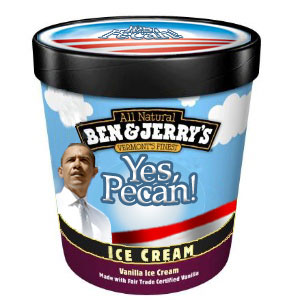
huge range of merchandise, from t-shirt and medallions to barbecue sauce and action figures, and Ben n Jerry's ice-cream have launched a new flavour, deliciously named 'Yes Pecan'. Even heroin dealers have got in on the act.


As amusing as all this might be, it is a brutal indication of how politics by consent in the world's wealthiest democracy is nothing more than a nice sounding idea, and the reality is that even the candidates representing change are as carefully packaged and marketed to us as high fashion or a blockbuster movie. The election itself is more like the Superbowl, in that it primarily consists of adverts and there's no discernible competition.

Another illustration of this increasing symbiosis between politics and marketing is the War on Terror, as it was initially labelled by George W Bush. This became 'the long war' after criticism, most beautifully from former Monty Python member Terry Jones:
TERRY: The “War On Terror” is nothing more than the act of declaring war on an abstract noun. Now you could say, “No, we’re declaring war on terrorists, not on abstract nouns,” but a terrorist doesn’t even exist until he’s committed a terrorist act. Just substitute something else for the word “terror” to make you see how ludicrous this is. Let’s say you declared war on “murder.” “Now we’ve declared war on murder and we’re not going to rest until ever murderer and every would-be murderer has been caught and brought to justice.” This is completely ridiculous! You can’t catch every one! Besides, they’re not even murderers until they’ve actually murdered someone! You can’t stop something happening before it happens! It’s a very dangerous situation that we’re now in and the people behind Bush, with his concepts of pre-emptive strikes around the world. They are a recipe for permanent warfare, disaster, chaos and I’m sorry to say, more terrorism. - Herecomethewilddogs
The name 'war on terror' was officially dropped by the US in July 2005, rebranding it then as the 'struggle against violent extremism'. The aim was not to clarify the situation, but to downplay the ongoing military aspects of the war. It was officially dropped in Britain in December 2007, though as the BBC notes the British and European media never took the phrase, often employing quotation marks when using it. Around this same period the portrayal of Al Qaeda changed, from being a hierarchical network to a 'brand', as MI5 head Jonathan Evans called it. The importance of this is that even those with no connection to Bin Laden, Zawahiri or any other leading Al Qaeda figure could still be considered a target in this war. As the Boston Globe pointed out:
Though distinguishing between groups that are officially part of Al Qaeda and those that are not may seem like splitting hairs, recognizing that not all jihadist groups or individuals are members of Al Qaeda helps us to understand that the "war on terror" is not just a war on Al Qaeda or groups affiliated with it. Rather, the war on terror is a war on a global jihadist movement of which Al Qaeda is only a part, albeit extremely influential. The common thread between all jihadist groups is that they share a similar ideology. Because this ideology does not derive its legitimacy from Al Qaeda or bin Laden, the jihadist movement will continue to exist whether there is a group called Al Qaeda or not. - Boston Globe
In August 2008 an internal British government document 'obtained' by the press revealed that it has become official policy to spread propaganda, both online and in more mainstream media, to 'taint the Al Qaeda brand':
The campaign aims to "channel messages" through internet bloggers and chatroom members as well as major media outlets such as the BBC.

It will seek to persuade people that the terrorist group is "in decline", and its operatives are "not heroes".

The strategy has been drawn up by the Research Information and Communication Unit (RICU) - which was set up by former Home Secretary John Reid and is staffed by officials from several Whitehall departments...

...However, the document stresses that the West should "avoid suggesting that AQ is no longer a threat". - Daily Mail

Indeed, this leaked document came in between Home Secretary Jacqui's Smith's warning in April that the threat was 'growing and severe', and Security Minister Lord West's claim in October that the security services are monitoring a 'great plot' by Al Qaeda. Strangely, Lord West was criticised for revealing such sensitive information, but hardly anyone said a word when two heads of MI5 and the Home Secretary essentially did the same thing. Moreover, a clearer example of official doublespeak you will not find - a counterterrorism unit is out spreading the news that Al Qaeda is weakened but all the while we're being warned that the threat is real and menacing. Al Qaeda really does show incredible flexibility as a brand, in that it seems to mean whatever the various vested interests require it to mean at different times.

More consolidated is the Obama brand, though in McGruder's response to being misquoted he showed great brevity and honesty in illustrating that there are cracks in the new president's carefully manufactured image. Initially he posted a brief message on his myspace:
Hey guys, never said Barack wasn't Black... please don't bother me with that bullshit. - myspace
However, he felt the need to clarify things further, and I for one am glad he did because his comments are right on the money not only regarding how his words have been treated by the media, but also on the corruption of the American democratic process and how little power the president has in the face of elite corporate-governmental institutions like the Federal Reserve.
For a long time now, I have tried to keep my opinions on the election and Barack Obama to myself. I occasionally do speaking engagements, which are not open to the press, and unfortunately some of my comments have been twisted around in a silly manner. The claim that I asserted our new President was not Black is categorically false. I have seen an endless stream of Black pundits on TV pontificating about the significance of President Obama’s election - many of them making reference to the 3/5th’s clause in the constitution regarding slaves. The point I was making is that this is not an accurate comparison. Barack is the son of an immigrant, not the descendant of slaves. It’s like comparing a half-Japanese man to the oppressed Chinese who built the American railroads. Yes, they are both Asian, but it is not an honest or accurate comparison. We all share the common experiences of being Black in America today - we do not all share a common history. A history that in part makes us who we are - and in some cases (as with the psychological damage that still lingers from slavery) holds us back. These are not, I believe, insignificant distinctions. I did say I was cautiously pessimistic about Obama’s Presidency - but this is simply acknowledging the reality of an American Empire that is out of control and on the verge of collapse. Let us not forget that on the eve of the election, we witnessed a near trillion dollar robbery of the US treasury. That robbery is still taking place. I do not blame President Obama, but I do not believe the financial and corporate interests that own and control this country will fold so easily. I do not question the integrity of the man as much as the power of his office - which I believe has greatly diminished over the years. I believe the Federal Reserve Bank, the Military Industrial Complex, and the massive corporate interests that run this country have more power than our new President. I hope I am wrong. After 9/11, I witnessed most of this country become obsessed with squashing dissent and silencing critics. I hope this election does not turn Black America towards this same, fascist mind state; but already I am starting to see it, and it saddens me greatly. I absolutely wish our new President and his family success and safety. But after all I have witnessed in my lifetime, and especially in the last eight years, I am not ready to lay down my skepticism or my outrage for this government. To do so would be unwise and, ironically enough, anti-American. - McGruder statement in full, Dailycartoonist
I have a feeling it will be some time before the mainstream press manages anything as intelligent and succinct as this on the subject of high and deep politics. In the meantime, enjoy one of the best episodes of the Boondocks, where Huey and the rest go to see Soul Plane 2.